Showing posts with label abstraction. Show all posts

Tuesday, July 23, 2013

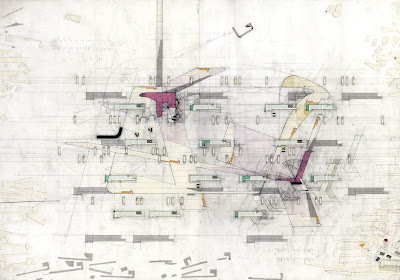
PERRY KULPER

Bleached Out:Relational Drawing

These drawings, nuanced dislocations, incomplete thoughts and approximate moments operate as resistance to the fixation of known figuration, or as typological reinforcement- they offer a thickened space of possibilities of growth through multiple, or manifold of relations.
- Kulper 
Central Califoria History Museum, Thematic drawing
Thematic Drawing, detail

For those who are interested, he writes about his work here.
Perry Kulper is also a teacher, and has taught courses similar to this one. Below are a range of works by students in one of these courses.


Project: Generative Removal
These projects focus on erasure as a means of generating an architectural proposition. Instead of contributing to architecture through additive means, the erasure work attempts to produce architecture through subtractive methods. Perry introduces an idea of “5 points of erasure as deconstructing towards a new architecture” which he likens to Le Corbusier’s “5 points of architecture.” 

The work started by creating a diptych which, on one side, had the floor plan of a famous villa or house. The other side of the diptych was to be populated with a series of “marks” whose character and placement was determined by a series of rules. Once the diptych was populated with marks, the work of erasure could begin. Again, a very specific set of rules was used to govern the removal and/or remembering of the marks. The two sides of the diptych were governed by the same rules and meant to be worked as a single drawing.
Catharine Pyenson
Shaoxuan Dong
Harry (Me)
Project: Real Slow

This work tackles what Kulper refers to as Relational Thinking. Students were asked to select an image and then redraw the image by revealing the relationships and hidden connections behind the original image. SImilarly to our first task, the focus is not on recreating the same image, but utilizing drawing methods to reveal what lies under the surface of the image.
Xiang Liu
Catharine Pyenson
Harry
Jeeeun Ham

CY TWOMBLY & MARK MAKING

Cy Twombly, Untitled, 1970
The title blackboard paintings comes from the grey, painted background, with its lighter areas resembling erasure. The large linear marks (made with wax crayon) evoke the idea of "something almost being said". But these are not chalk marks on a blackboard, so the writing cannot be wiped away. The drawing is stuck in a tension between permanance and impermanence.


Some of the works in the series use just one form of mark, amplifying it; others play off several kinds of line with each other. The paintings operate in a language that only some of us speak: some elements are recognisable and categorisable; but even without writing a recognisable language, they act to evoke mysteries and emotion. Each work, says Roberta Smith (1987, p18) "is a kind of demonstration or rumination upon some isolated fact of gesture, movement or measurement. These paintings are...motion studies that diagram the action of air, water or the arm itself."


Untitled, 1968
The repeated looped elements resemble handwriting exercises, yet making the paintings is an unpredetermined process aiming for any particular outcome, and the viewer's experience is not about any particular mark or line, but about the repetition of the process and the accumulation of lines. Within the gesture of the loop, the effect of layering seems almost random, yet it is this process that generates the complexity of the painting, balancing order and disorder, randomness and control. The accumulation of lines flattens the field of the canvas, not offering a focal point. Even so, the drawing-as-handwriting makes the large canvas into an intimate and personal space. The intimate scribble has been skillfully scaled up. This physical release of energy from the hand speaks about nothing, but communicates a tremendous amount.

Here, the line is a visible action, liberated from the dictates of material; Barthes (1985) wrote that "however supple, light or uncertain it may be, [it] always refers to a force, to a direction; it is an energon, a labor which reveals - which makes legible - the trace of its pulsion and its expenditure."


Cy Twombly, "Wilder Shores of Love"

Cai Guo-Qiang. Gunpowder
Joel Shapiro, "Untitled", 1969, Fingerprints on Graph Paper.
Jo Lankester, Echlin St Quarry Juxtaposition 1, right panel, 2010, Etching Aquatint


Untitled, 1970.
Oil-based house paint and crayon on canvas, 405 x 640 cm.
 MoMA, New York