Cy Twombly, Untitled, 1970
The title blackboard paintings comes from the grey, painted background, with its lighter areas resembling erasure. The large linear marks (made with wax crayon) evoke the idea of "something almost being said". But these are not chalk marks on a blackboard, so the writing cannot be wiped away. The drawing is stuck in a tension between permanance and impermanence.
Some of the works in the series use just one form of mark, amplifying it; others play off several kinds of line with each other. The paintings operate in a language that only some of us speak: some elements are recognisable and categorisable; but even without writing a recognisable language, they act to evoke mysteries and emotion. Each work, says Roberta Smith (1987, p18) "is a kind of demonstration or rumination upon some isolated fact of gesture, movement or measurement. These paintings are...motion studies that diagram the action of air, water or the arm itself."
 |
| Untitled, 1968 |
The repeated looped elements resemble handwriting exercises, yet making the paintings is an unpredetermined process aiming for any particular outcome, and the viewer's experience is not about any particular mark or line, but about the repetition of the process and the accumulation of lines. Within the gesture of the loop, the effect of layering seems almost random, yet it is this process that generates the complexity of the painting, balancing order and disorder, randomness and control. The accumulation of lines flattens the field of the canvas, not offering a focal point. Even so, the drawing-as-handwriting makes the large canvas into an intimate and personal space. The intimate scribble has been skillfully scaled up. This physical release of energy from the hand speaks about nothing, but communicates a tremendous amount.
Here, the line is a visible action, liberated from the dictates of material; Barthes (1985) wrote that "however supple, light or uncertain it may be, [it] always refers to a force, to a direction; it is an energon, a labor which reveals - which makes legible - the trace of its pulsion and its expenditure."
Cy Twombly, "Wilder Shores of Love"
 |
| Cai Guo-Qiang. Gunpowder |
 |
| Joel Shapiro, "Untitled", 1969, Fingerprints on Graph Paper. |
 |
| Jo Lankester, Echlin St Quarry Juxtaposition 1, right panel, 2010, Etching Aquatint |
 |
Untitled, 1970.
Oil-based house paint and crayon on canvas, 405 x 640 cm.
MoMA, New York |


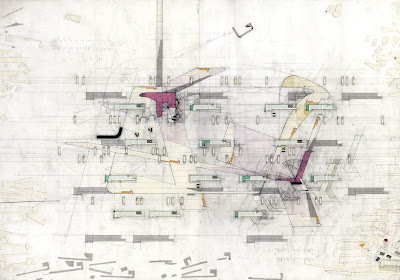


 Shaoxuan Dong
 Harry (Me)
 Xiang Liu
 Catharine Pyenson
 Harry
Harry Jeeeun Ham


